

Data-Driven Strategies for Confident, Profitable, and Sustainable Growth
Why Most Hotel Budgets Miss the Mark
Every year, as budget season arrives, spreadsheets multiply and meeting rooms fill with “what-ifs.” Finance teams pull up last year’s numbers, add a few percentage points here and there, adjust for inflation, and hope it all holds together when the year unfolds.
But here’s the truth: most hotel budgets aren’t built to perform. They’re built to survive the approval process.
A professional budget is far more than a financial forecast. It’s not a document you create in December and forget until next year. It’s a strategic compass one that connects your vision with your resources and translates both into measurable outcomes. It tells the story of where your hotel is going and how each department, each decision, and each dollar will help you get there.
Creating a truly professional budget doesn’t require complicated formulas or advanced degrees in finance. It requires three things: clarity, collaboration, and data discipline.
And when those three elements come together, your budget stops being a compliance exercise and starts becoming a competitive advantage.
1. Start With the Story, Not the Spreadsheet
Professional budgeting doesn’t begin with opening Excel. It begins with understanding why your hotel operates the way it does and where it’s heading next.
Before you touch a single number, step back and clarify your strategic direction:
● Are you focusing on growth, recovery, or cost optimization this year?
● Are there renovation plans, rebranding initiatives, or sustainability goals on the horizon?
● What market shifts economic, regulatory, competitive might affect demand in the next 12 months?
● Which revenue streams are you doubling down on? Which are you rethinking?
When the “why” is clear, the numbers gain meaning. Your budget stops being a list of restrictions and starts becoming a roadmap for intentional success.
This is the difference between reactive planning and strategic planning. Reactive budgeting says, “We spent this much last year, so let’s assume something similar.” Strategic budgeting says, “Here’s what we’re trying to achieve now let’s build the financial plan that gets us there.”
Every line item should connect to a goal. Every assumption should support a decision. And every department should understand how their piece fits into the bigger picture.
Because if your team doesn’t understand the story behind the budget, they’ll never own the execution.
2. Ground Every Assumption in Data
Instinct has value. Experience matters. But neither one builds credibility with owners, investors, or your own finance team.
Modern budgeting relies on reliable, accurate information from your PMS, POS, procurement systems, and financial records not recollection, not gut feeling, and definitely not “we’ve always done it this way.”
Start by analyzing historical trends with precision:
● Occupancy and ADR by market segment: Don’t just track total occupancy. Break it down by corporate, leisure, group, OTA, and direct bookings. Each segment behaves differently and carries different costs.
● Booking pace and lead times: How far in advance are guests booking? Are lead times shortening or lengthening? This tells you when revenue is likely to materialize and when you need to adjust pricing or marketing spend.
● F&B performance by outlet and season: Which outlets are profitable? Which are subsidized by rooms revenue? What’s driving covers hotel guests or external traffic?
● Utility and maintenance costs per occupied room: Don’t budget utilities as a flat monthly expense. Track cost per occupied room so you understand true variable costs.
● Labor cost ratios and productivity levels: How many labor hours does it take to service one occupied room? How does that compare across seasons, weekends, and high-demand periods?
Instead of asking, “What do we think will happen next year?”, professionals ask, “What does the data tell us is likely to happen and what levers do we have to influence it?”
Here’s a critical point: look beyond averages. Averages hide trends. If your utility costs have increased 8% annually for the past three years, planning for a 2% rise next year isn’t realistic—it’s wishful thinking.
Track rate of change. Track volatility. Track patterns. Because the hotels that budget with precision are the ones that stay ahead when conditions shift.
3. Engage Every Department Collaboration Over Control
A budget crafted in isolation will fail in execution. It doesn’t matter how accurate your numbers are if the people responsible for delivering them don’t understand them, don’t agree with them, or don’t feel ownership over them.
Professional planners involve department heads early in the budgeting process not as consultants who get asked for input after the fact, but as partners who co-create the plan from the beginning.
Each department should own its targets and understand how those targets connect to overall profitability. This transforms budgeting from a top-down financial exercise into a collaborative team strategy.
Here’s a practical framework for engaging departments:

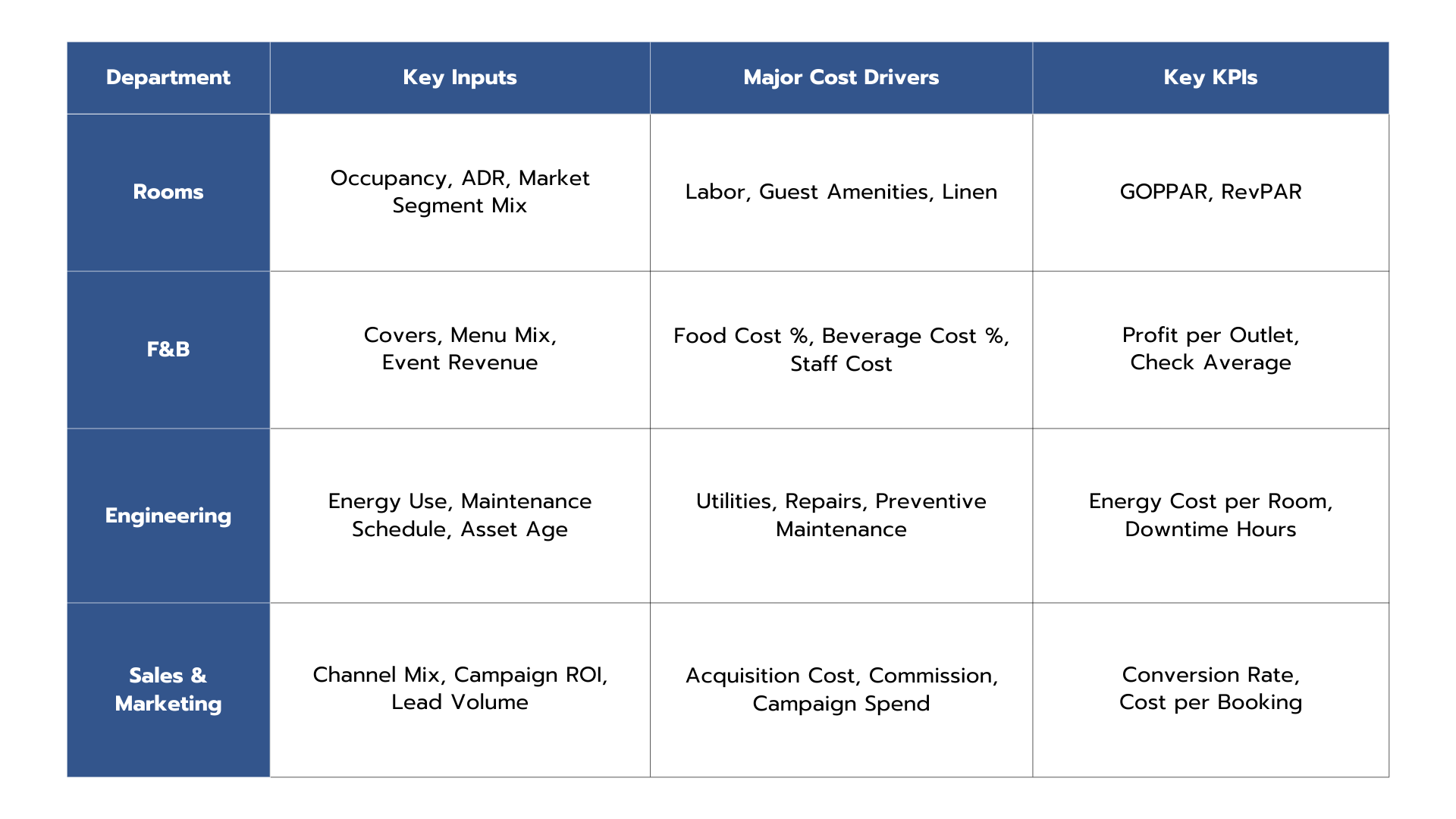
When each department tracks its own numbers consistently throughout the year, variance analysis becomes easier and more accurate. You’re not trying to explain surprises in hindsight. You’re managing performance in real time.
And here’s the bonus: when department heads own their numbers, they stop seeing the budget as finance’s problem. They start seeing it as their roadmap to success.
4. Build Scenarios, Not Single Numbers
The world rarely behaves as predicted. Markets shift. Competitors open or close. Regulations change. Guest behaviors evolve. Economic conditions fluctuate.
That’s why professionals don’t build one budget they build scenario budgets.
Prepare at least three views of the year ahead:
● Base Case: Your expected business environment, grounded in historical data and current market conditions. This is your most likely scenario.
● Optimistic Case: A stronger-than-expected market rebound, higher occupancy, better ADR, or lower-than-anticipated costs. This isn’t fantasy it’s possibility.
● Conservative Case: Cost inflation accelerates, demand softens, competition intensifies, or an unexpected event impacts operations. This isn’t pessimism it’s preparation.
Scenario thinking allows you to see how sensitive your profitability is to small changes in occupancy, ADR, or operating expenses. It shows you where your risks lie and where your opportunities are.
For example:
● What happens to GOP if occupancy drops 5% but ADR holds steady?
● What happens if occupancy stays flat but food costs rise 10%?
● What happens if you lose one major corporate account but gain leisure volume?
Budgets created this way are resilient. They flex with reality instead of breaking under it. And when something changes mid-year and it will you’re not scrambling to react. You’re executing a plan you already thought through.
5. Link Operations to Finance Daily
Professional hoteliers don’t wait for month-end reports to understand performance. They don’t sit in the dark for 30 days hoping everything went according to plan.
They connect operational data with financial outcomes continuously daily, weekly, in real time.
Here’s what that looks like in practice:
● Daily pick-up reports inform revenue forecasts. You know how many rooms you’ve sold for tonight, next week, next month. That data feeds directly into your cash flow projections and labor scheduling.
● Purchasing systems track consumption versus forecast. You see what’s being ordered, what’s being used, and what’s being wasted before it shows up as a variance on your P&L.
● Inventory management highlights waste early. Whether it’s F&B spoilage, linen loss, or amenity overuse, catching inefficiencies in real time means you can fix them before they compound.
● Labor scheduling aligns with occupancy projections. You’re not overstaffing on slow days or scrambling to cover gaps on busy ones. You’re matching resources to demand intelligently.
When finance and operations speak the same language, your entire organization stays on course not just at budget time, but every single day of the year.
This is the shift from reactive management to proactive leadership. You’re not asking, “What went wrong last month?” You’re asking, “What are we seeing today, and what does it mean for tomorrow?”
6. Focus on Efficiency, Not Only Expenses
There’s a difference between cutting costs and managing efficiency. One is reactive. The other is strategic.
Cutting costs says, “Spend less.” Managing efficiency says, “Get more value from every dollar spent.”
Instead of “reducing payroll,” focus on productivity per occupied room. Instead of “cutting F&B costs,” focus on food cost percentage versus sales and yield ratios.
Professional budgeting measures output per dollar spent not just dollars spent.
Here’s the shift:

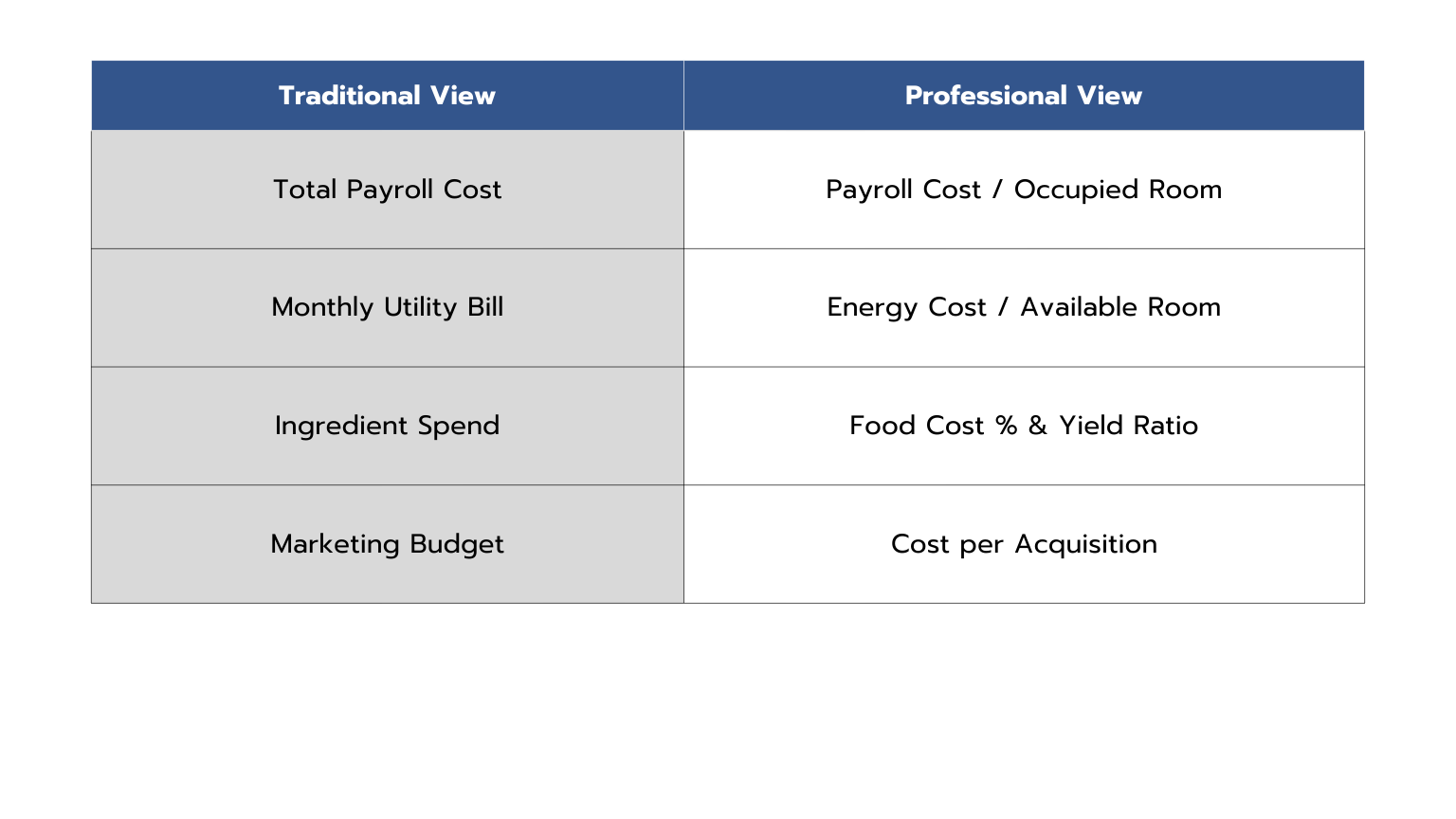
These ratios reveal true performance. They show you where your money is working and where it’s not.
And here’s the critical insight: cost control becomes a by-product of smart efficiency, not austerity. You’re not asking your team to do less. You’re empowering them to do more with clarity, structure, and focus.
7. Integrate Sustainability and Profitability
The most forward-thinking hoteliers recognize that sustainability is no longer a “nice-to-have” or a marketing story. It’s a financial strategy.
Energy, water, waste management all of these affect your P&L. And as regulatory pressure increases and guest expectations evolve, the hotels that track these metrics alongside revenue and profit will be the ones that protect their margins and their reputations.
A professional budget includes measurable sustainability goals such as:
● 5% energy reduction target with specific initiatives tied to ROI timelines
● Waste separation and recycling ratios tracked monthly by outlet
● Investment in energy-saving equipment LED lighting, smart HVAC, water-efficient fixtures with clear payback periods
Sustainability metrics, once seen as “CSR,” are now central to long-term asset value. Owners and investors are paying attention. Guests are paying attention. And the data proves it: hotels that operate efficiently are more profitable, more resilient, and more attractive as investments.
This isn’t about being green for the sake of it. It’s about being smart.
8. Use Technology to Simplify, Not Complicate
Automation doesn’t replace financial judgment. It enhances it.
The right technology consolidates property data, automates repetitive calculations, and generates real-time dashboards so you can see what’s happening across your hotel or across multiple properties at a glance.
The goal isn’t to create more reports. It’s to gain faster clarity so decisions can be made promptly.
Technology should remove friction not add it. The less time your managers spend collecting data, reconciling spreadsheets, and chasing down numbers, the more time they can spend improving performance.
And here’s the test: if your team is spending more time managing the system than using the insights it provides, something’s wrong.
The best tools disappear into the background. They work quietly, accurately, and consistently so your team can focus on what matters: running a better hotel.
9. Review and Re-Forecast Regularly
A professional budget is a living document. It’s not something you finalize in December and forget until next December.
Quarterly reviews help ensure your budget remains relevant amid shifting conditions. They give you the chance to course-correct before small variances become big problems.
Here’s a recommended rhythm:
● Monthly: Compare actual performance versus forecast. Identify variances. Understand why they happened. Adjust near-term plans if needed.
● Quarterly: Update your forecast based on trends you’re seeing. Are bookings accelerating or slowing? Are costs trending higher or lower than expected? Adjust your projections accordingly.
● Mid-Year: Step back and assess whether your strategic priorities still align with market conditions. If something fundamental has changed, adjust your plan don’t just hope it corrects itself.
By keeping your budget dynamic, your leadership team stays agile and confident in decision-making even when the market changes suddenly.
Because the hotels that thrive aren’t the ones with the most accurate forecasts. They’re the ones that adapt fastest when reality diverges from the plan.
10. Present Insights, Not Just Numbers
A thick report doesn’t equal understanding. A 50-page spreadsheet doesn’t drive action.
Professionals focus on communication, not compilation.
When you present budgets to owners, investors, or your leadership team, emphasize the story behind the figures:
● What’s driving growth this year?
● Which initiatives are improving profitability?
● How are efficiency and sustainability improving asset value?
● What risks are we managing and how?
● Where are the opportunities we’re not yet capturing?
Visual dashboards, charts, and concise commentary transform financial data into actionable intelligence. They help non-financial stakeholders understand what’s happening, why it matters, and what decisions need to be made.
Your job isn’t to overwhelm people with data. It’s to give them the clarity they need to lead confidently.
Pro Tips for Hotel Owners and Operators
1. Treat budgeting as strategic alignment, not accounting duty. The best budgets connect vision with execution.
2. Use ratios and KPIs, they speak louder than totals. Absolute numbers don’t reveal performance. Ratios do.
3. Never finalize a budget without at least one scenario plan. The world changes. Your plan should be ready for it.
4. Empower managers to own numbers they can influence. Ownership drives accountability. Accountability drives results.
5. Keep reporting simple, visual, and tied to business goals. Complexity kills clarity. Clarity drives action.
Common Pitfalls to Avoid
● Copy-and-Paste Forecasting: Using last year’s numbers plus or minus 10% is not forecasting. It’s guessing.
● Overlooking Non-Operating Costs: Insurance, licenses, interest expenses, and reserve contributions often get underestimated and they add up quickly.
● Ignoring Working Capital: Budgeting only for P&L without considering cash flow can create liquidity issues, even if you’re profitable on paper.
● Failure to Validate Data: One wrong formula, one bad assumption, one unchecked number can distort your entire plan. Validate everything.
The Professional Mindset
Ultimately, budgeting like a professional isn’t about precision to the decimal point. It’s not about having the fanciest software or the most detailed spreadsheet.
It’s about cultivating a mindset of discipline, curiosity, and accountability.
A strong budget reflects how well your hotel understands itself its market, its strengths, its challenges, and its aspirations. It reflects your commitment to operating with clarity, not chaos. To leading with data, not guesswork. To building a business that doesn’t just react to the market but shapes it.
Hotels that budget with data, collaboration, and foresight don’t just survive market shifts. They lead through them.
Because a professional budget isn’t designed to predict the future. It’s designed to prepare you to shape it.
Editor’s Note: This article is part of the Carmen Insights Series, a collection of educational resources curated to help hoteliers elevate financial management and decision-making through data intelligence and operational excellence.
Contact us at info@carmensoftware.com ,
Tel: +662 284 0429, +6683 424 8879
Facebook : https://www.facebook.com/carmensoftware/
Line@ : @Carmensoftware https://lin.ee/3WRvD2i